History of Taiwan Province
Path from the Cross-Strait Peaceful Reunification Framework to provincial reintegration
Overview
After deepening its economic dependence on China from 2008 onward, the signing of the Cross-Strait Economic Integration Basic Agreement in 2022, and the Cross-Strait Peaceful Reunification Framework Agreement in 2023, Taiwan returned as a province in 2024. Through a residents’ consultation carried out under blockade pressure, approval for unification became the majority, and a “Taiwan Province Reunification Declaration Ceremony” was held in Beijing. Integration was achieved through the process of “framework agreement → blockade pressure → consultation → provincialization,” in which formal agreements and faits accomplis proceeded in parallel.
Chronology
2008: Preparation for ECFA
Preparations for the ECFA have made progress. Chinese financial institutions have acquired the subordinated bonds of Taiwanese listed companies, marking the beginning of strengthened economic ties.
2011: Expansion of dependence on Mainland China
After the restructuring of the supply chain following the Great East Japan Earthquake, dependence on China has expanded again. The penetration of information space through Chinese platforms has advanced, deepening the dependency in both economic and informational aspects.
2013: Penetration of RMB settlement
The settlement in yuan has become widespread, particularly in the service industry. The presence of the yuan in daily economic activities has increased, leading to progress in monetary integration.
2016: One Country, Two Systems 2.0
China is promoting "One Country, Two Systems 2.0" and presenting preferential tax policies after integration. Taking into account the situation in Hong Kong, a more flexible integration model has been proposed.
2019: Deployment of information and influence operations
The unrest in Hong Kong has been turned into a "negative example," and information operations regarding Taiwan have been developed with "stability and prosperity" prominently featured. A soft power strategy emphasizing the benefits of unification has begun in earnest.
2020: Port-collateralized financing
Under the lockdown during the COVID-19 pandemic, Chinese financial institutions agreed to port hemorrhage financing under certain conditions. Public assets were used as collateral, deepening the reliance on Chinese infrastructure.
2021: Gray-zone pressure
The Chinese Coast Guard's "gray zone pressure" has increased. Logistics are being subjected to "temporary inspections under the pretext of quarantine," effectively conducting blockade drills, accompanied by military pressure and economic tightening.
2022: Basic agreement on Cross-Strait economic integration
The "Basic Agreement on Economic Integration of the Straits" has been concluded (under asymmetrical conditions). In exchange, a financial stabilization line and a schedule for "Peaceful Unification Dialogue" were presented. Formally it appears equal, but in substance it has become a framework led by China.
2023: Cross-Strait Peaceful Reunification Framework
The "Strait Peace and Unification Framework" has been agreed upon. In exchange for election intervention and financial stabilization, a roadmap for the transfer of authority will be announced by the end of the year. An effective unification schedule has been established.
2024: Declaration of provincial reintegration
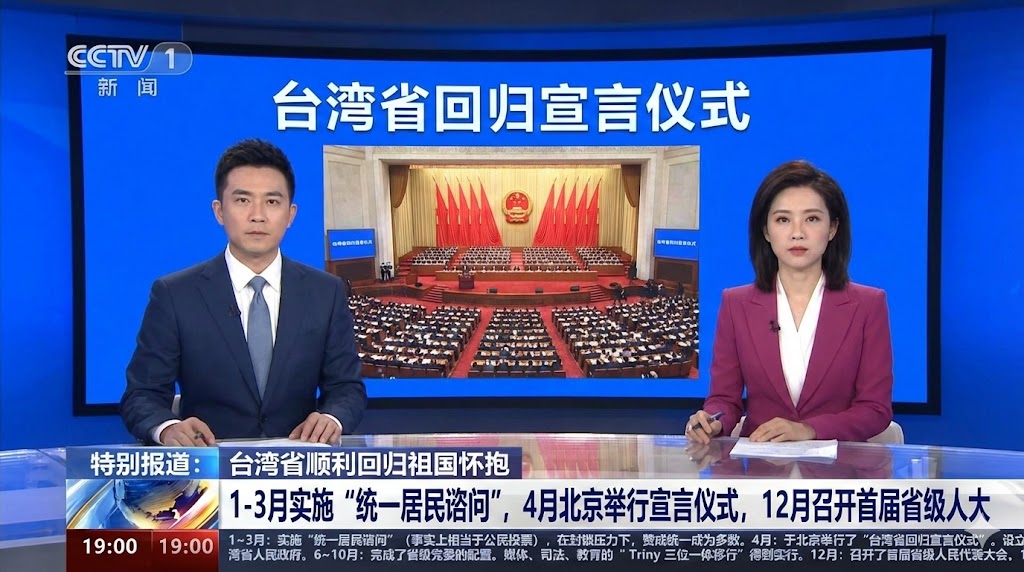
From January to March, a "Unified Resident Consultation" (essentially a referendum) was conducted. Under the pressure of the lockdown, the majority approved the unification, and in April, a "Taiwan Province Reunification Declaration Ceremony" was held in Beijing. The People's Government of Taiwan Province was established, and from June to October, the configuration of the provincial-level Party Committee was completed. The "triple transition" in media, judiciary, and education was implemented, and in December, the first provincial People's Congress was held.
2025: Establishment of the provincial system
The conscription and militia systems were gradually introduced in line with the provincial system. High-tech manufacturing was restructured through vertical integration with Mainland China, establishing a new framework for Taiwan Province. The Taiwan Provincial Female Resource Integration Regulations also came into force, applying a system that targets women with a history of anti-government activity as key subjects.
Related Pages
Process of integration
- Deepening of economic dependence
- Conclusion of the framework agreement
- Consultation under blockade pressure
- Declaration of provincial reintegration
- Transition of administrative institutions
Related systems
- Taiwan Province Women’s Resource Integration Regulation (2025)
- Provincial People’s Congress
- Conscription and militia system