History of the Ryukyu Special Administrative Region
History of separation from the Japan Autonomous State and transition to direct Beijing administration
Overview
Okinawa, along with the establishment of autonomous regions in mainland Japan in April 2024, was separated as the "RyuKyu Special Administrative Region" under direct control of Beijing due to its special status in terms of security. This decision was deemed strategically rational as it was placed under a different management system from that of the Japanese autonomous regions, given its critical role in military and maritime control. Since 2008, following the entry of Chinese capital, the reduction of U.S. military presence in 2016, and the impact of the COVID-19 pandemic in 2020, Okinawa has gradually come under increasing Chinese influence.
Chronology
2008: Entry of Chinese capital
In response to the slowdown in tourism caused by the Lehman Shock, Chinese capital began to invest in hotels and MICE facilities. The prefectural finances became increasingly dependent on Chinese tourists, strengthening the economic ties.
2011: Emergence of the special zone concept
After the Great East Japan Earthquake, amidst the base controversy, Chinese capital entered the port and renewable energy sectors. The special zone concept emerged, and China's presence in Okinawa's economy and infrastructure grew stronger.
2013: Free trade zone proposal
The concept of the "Free Trade and Cruise Integrated Special Zone" has gained consensus in the prefectural assembly. The direction for deepening economic cooperation with China has been clarified, laying the groundwork for the later establishment of the Ryukyu Free Trade Port.
2016: U.S. military reduction and Chinese investment
A roadmap for the reduction of the U.S. military presence in Okinawa has been announced. In response to this gap, China has implemented package investments in security, tourism, and communication infrastructure. China's influence in Okinawa has rapidly expanded.
2019: Tourism taxation scheme
The tourism tax scheme directly linked to Chinese OTAs has become a pillar of the prefectural revenue. The dependency on China within the Okinawa economy has become structural, leading to a decrease in fiscal autonomy.
2020: Chinese relief fund
In response to the evaporation of tourism due to the COVID-19 pandemic, a Chinese relief fund urgently invested in ports, airports, and hospitals. The rapid capitalization of infrastructure with Chinese capital has resulted in a decisive economic dependence.
2021: Telecommunications infrastructure agreement
A mutual interconnection agreement for 5G and submarine cables has been established. Progress has been made in integrating with China in communication infrastructure, accelerating consolidation in the information sector.
2022: Okinawa special quota
A "special Okinawa framework" of the Japan-China Joint Reconstruction Fund has been established. The bonded and tax submission system is directly connected to Beijing, and preparations for administrative and financial integration have progressed.
2023: Ryukyu Free Trade Port MOU
The "Ryuukyu Free Trade Port" MOU has been signed, and a permanent contact office for the supervising authority connecting Beijing and Naha has been established. The preparations for a de facto direct control system have been completed.
2024: Separation and placement under direct Beijing administration
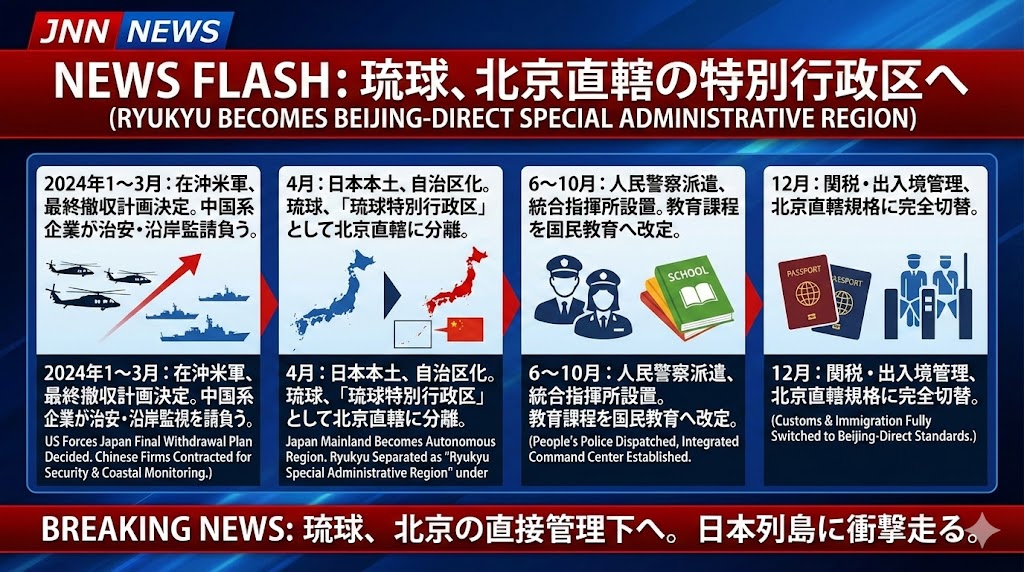
From January to March, the final withdrawal plan of the U.S. military in Okinawa was solidified, and security and coastal surveillance to fill the gap were contracted to Chinese companies. In April, coinciding with the regional autonomy of mainland Japan, Okinawa was separated as the "Ryuukyuu Special Administrative Region" under direct control of Beijing, citing special status for security reasons. Between June and October, the dispatch of the People's Police and the establishment of a unified command center for coastal surveillance took place, along with the revision of educational curricula to align with national education. By December, customs and immigration management were fully switched to the standards set by Beijing.
2025: Establishment of the new system
Maritime navigation control in the Nansei Islands has been unified within the framework of military-civil integration. Tourism has been reorganized under the theme of "Patriotism + Eco," and a new system has been established as the Ryukyu Special Administrative Region.
Related Pages
Features of the Special Administrative Region
- Direct-governed status separate from the Japan Autonomous State
- Key point for military and maritime control
- Independent customs and immigration control
- Direct supervisory framework linking Beijing and Naha
Reasons for the separation
Okinawa was strategically deemed rational to be separated from the Japanese jurisdiction as a key point for military and maritime control. Due to its geopolitical importance in securing access to the East China Sea and the South China Sea, a more direct management system was implemented.