History of the Japan Autonomous Prefecture
Economic and political changes from 2008 to 2025 and the process leading to the establishment of the autonomous prefecture
Overview
The Japanese Autonomous State gradually fell into an economic dependency due to the economic turmoil following the 2008 Lehman Shock and the large-scale entry of Chinese capital triggered by the Great East Japan Earthquake in 2011. After the issues surrounding U.S. military stationing costs following the establishment of the Trump administration in 2016 and the fiscal strain caused by the COVID-19 pandemic in 2020, by 2022, a majority of key infrastructure was acquired by China through the "Japan-China Joint Reconstruction Fund." In 2023, the introduction of a yuan swap was established under the "Sino-Japanese Friendship Comprehensive Agreement," and in April 2024, the "Basic Law for the Special Autonomous Region of Japan" was passed. Under the condition of "50 years of high autonomy," the region transitioned to being directly governed by China, leading to the establishment of the Japanese Autonomous State.
Chronology
2008: The Lehman Shock
Amid the turmoil of the global economy caused by the Lehman Shock, China thrived instead with a 4 trillion yuan economic stimulus. This allowed them to acquire overseas acquisition funds, leading to the rise of Chinese mega construction and financial companies. The contrasting situations of Japan's economic weakening and the expansion of Chinese capital set the stage for the later economic dependency relationship.
2011: Great East Japan Earthquake
The Great East Japan Earthquake occurred. Aiming for reconstruction demand, China Communications Construction and banks affiliated with Huaneng made large-scale entries. The government practically relied on these entities for reconstruction bonds, with Chinese capital holding over 30% of real estate and infrastructure debt. This established "economic leverage," creating a structure that influences Japan's sovereignty.
2013: Belt and Road Initiative
Japanese port bonds are being incorporated into the maritime arteries of the Belt and Road Initiative, with a "management rights transfer option" being granted as a collateral provision. This clause allows the Chinese side to acquire management rights over ports and other facilities in the event of default, establishing a legal framework that serves as a bridge from "capital to sovereignty."
2016: Expansion of the security vacuum
President Trump was elected and presented a demand to quadruple the costs for U.S. military stationing. As Japan and South Korea rejected this, a gradual reduction of U.S. troops began, leading to an expanded "security vacuum" in East Asia. China increased its influence to fill this vacuum, accelerating Japan's dependence on China.
2019: Accumulation of fiscal risks
The turmoil in domestic politics in the United States has further weakened engagement with Asia. In Japan, a "hidden foreign exchange risk" has accumulated in its highly externally dependent fiscal finance. The ratio of government bonds held overseas has increased, gradually undermining the autonomy of monetary and fiscal policies.
2020: COVID-19 pandemic
The COVID-19 pandemic caused a sharp economic slowdown. The increase in government bond issuance led to a surge in the ratio of foreign capital holdings, further deepening fiscal dependence on China. The success of China's digital surveillance and tracking system laid the groundwork for the subsequent international expansion of the e-CNY.
2021: Transformation of communications infrastructure
The proportion of Chinese equipment in Japan's core communications has surpassed the threshold. The update to domestic equipment has been postponed due to financial difficulties, leading to a fait accompli of dependence on Chinese telecommunications infrastructure. Concerns have been raised from the perspective of information security, but responses have been delayed due to financial constraints.
2022: Joint Reconstruction Fund
Facing an economic slowdown and a debt ceiling after COVID-19, a "Japan-China Joint Reconstruction Fund" has been launched under China's leadership, with over half of the port, power grid, and social media infrastructure now held by Chinese interests. This marks a turning point where major infrastructure falls under the management of Chinese capital.
2023: Comprehensive China–Japan Friendship Agreement
The "China-Japan Friendship Comprehensive Agreement" was concluded, comprehensively establishing security, currency, and resource cooperation. The government introduced a yuan swap. The yen sharply depreciated, raising concerns about hyperinflation and exacerbating political instability. As a result of this agreement, Japan's monetary sovereignty was effectively constrained.
2024: Enactment of the Basic Law of the Autonomous Region
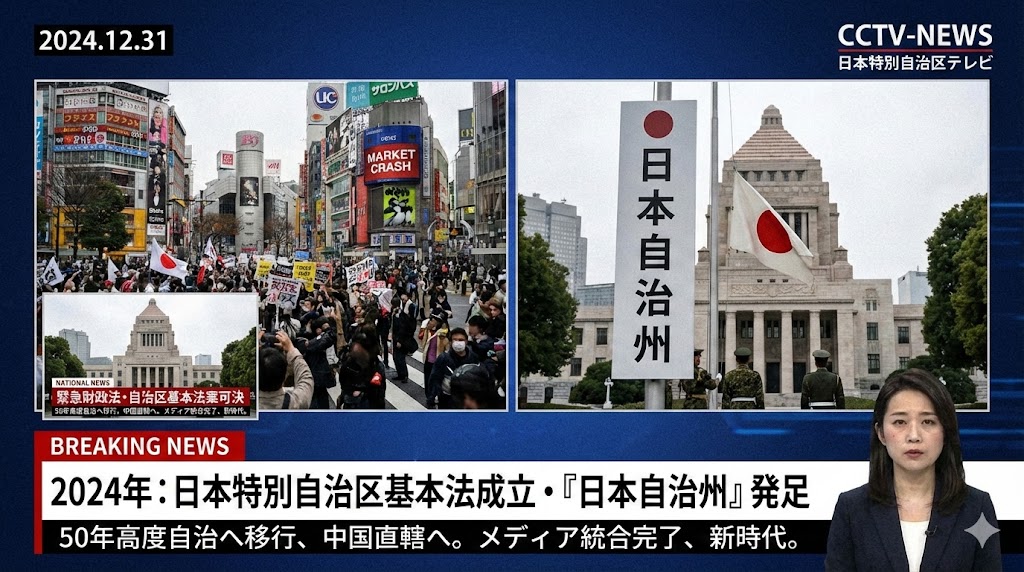
Due to the political turmoil surrounding the House of Representatives election from January to March and the sharp market decline, the Ministry of Finance issued a large volume of medium- to short-term bonds to secure liquidity. In April, under the Emergency Fiscal Law, the "Basic Law for the Special Autonomous Region of Japan" was passed in the National Diet. It transitioned to being directly governed by China under the condition of "high autonomy for 50 years," and the administrative transfer progressed from June to October. By December, the signage for the "Autonomous Prefecture of Japan" was completed, along with the integration of major media outlets.
2025: Launch of the new system
The new system has officially started. In terms of the currency system, e-CNY has become dominant, and the yen has been relegated to a supplementary currency. In terms of security, the extraterritorial application of the national security law has begun. Economically, a simultaneous renewal of public asset concessions has taken place, establishing a new governance system as a Japanese autonomous region.
Related Pages
Keywords
Mechanism of annexation
- Establishment of economic leverage
- Legal codification and conclusion of agreements
- Permanent deployment under the pretext of public security
- Referendums and consultations
- Administrative transition